Tuesday, January 14, 2014

An Early Library for Lynchburg


Working at the Lynchburg Museum can be a lot like Christmas. When the Curator and staff are tracking down items for exhibits, they may open a box and become distracted by other artifacts. This is exactly how January’s Awesome Artifact was discovered.


January’s artifact is the 1883 novel Jenifer by Annie Thomas, enclosed in a book cover that proclaims: “The Lynchburg Circulating Library, owned and conducted by J. D. Suter & Co., Booksellers and Stationers, No. 1017 Main Street.” Investigating the origin of a single item easily becomes a history lesson. In this case, a single glance into an archival folder yielded an item which can be traced back to the beginning of an institution which today is taken for granted: the public library. Early libraries were not free. In the late 1800s many of the well-educated and wealthy had personal libraries or the money to borrow books from circulating libraries such as Suter’s.  There was not a true public library for all Lynchburg residents to patronize until 1966.   


For a small fee, one could borrow and read a book like Jenifer, Selected Poems of Matthew Arnold, or a Dickens Reader. These books were available through subscriptions offered to businesses ($10/year). Harper & Brothers (the future HarperCollins) published 52 books a year especially for this purpose under the Harper Franklin Square Library imprint. 


For several years J. D. Suter owned a prominent bookselling and library business on Main Street. His letterhead boasts a variety of items available, from school books, sheet music, and gold pens to imported stationery. It also states “Rare Books, and Books that are Out of Print, Obtained at Short Notice.” The credit account for Mrs. I. S. Moore in July of 1886 lists purchased items such as N. Y. Fashion B’zar, Maurice Mystery, and the service of “Repairing Gold Pen.” Other receipts in the Museum’s collection include items like ink holders, pencils and blank books, 3 volumes of Scott’s History, Swinton’s Complete Geography, Bingham’s Latin Grammar, valentines, toothpicks, games of Cock Robin, and a vase. 


In the Trade Notes section of an 1884 issue of The American Bookseller, Suter announced: “…that his business has been enlarged by the taking-in of a partner, and that a job office will be added to their other business.” Suter & Co. also placed an ad in an 1884 Publisher’s Weekly which may have been to fulfill requests from customers, either for purchase or for the circulating library: 

Books Wanted
John D. Suter & Co., Lynchburg, Va.

Philostratus’s Life of Apollonius of Tyana, tr. By Rev. Ed. Berwick
The Jesus of History, by Sir R. D. Hanson
The New Virginians, Blackwood, 1879.
Wolfenbuttel, Fragments, tr. By C. Voysey.
Lyle’s Collection of Poems and Ballads, 1827.

Suter’s eventually closed and the Museum could not locate any images of the actual store, but for a time, it seemed to offer Lynchburg a little bit of everything. J. D. Suter died sometime before 1900, leaving a widow, Fannie. 

As the past intersects with the present, it leaves many thinking about the fate of libraries and bookstores because of the digitization of printed matter. With so much information available on the internet (but unfortunately, much of it inaccurate), libraries are not the public institutions they used to be. Neither are the brick and mortar bookstores, though books continue to sell through online vendors. Some wonder if all physical books will become relics or artifacts, but time will tell.

Business Card of John D. Suter & Company's First Location

Wednesday, December 18, 2013

STEADFAST SOLDIERS FROM THE FIVE AND DIME


Infantryman
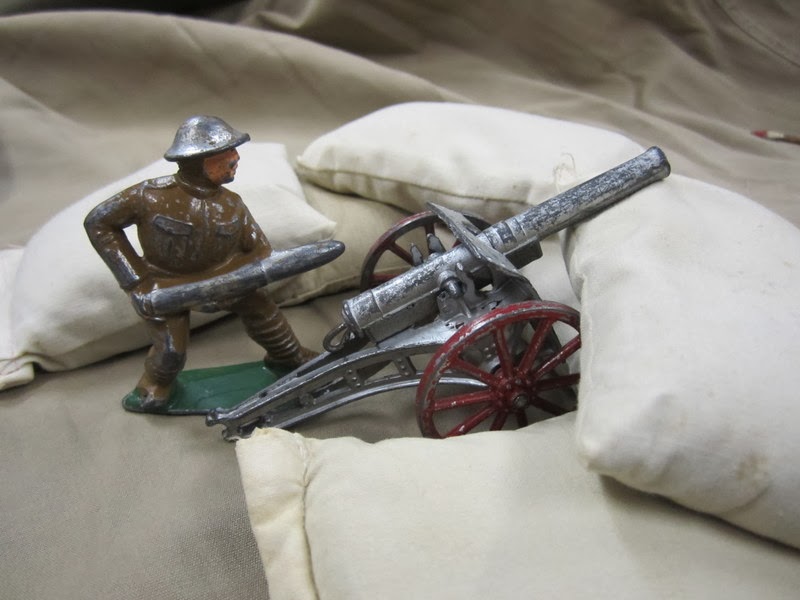
In 2008 the Lynchburg Museum acquired a large collection of toy soldiers from Mr. Buddy Schmidt. These are not the typical tin soldiers associated with the Christmas tale; these soldiers are made of lead. Likely, the toy soldiers were produced by the Barclay Manufacturing Company, which was located in West Hoboken, New Jersey. Barclay became famous for its line of “Dimestore Doughboys,” several of which are pictured here. Reproductions may still be purchased from the Barclay website.[i]

Source: http://www.barclaycompany.com

The term “Dimestore” comes from the most common place a little boy could buy his toy soldiers – the “Five and Dime” store.  The average price of the items in their bins was either a nickel or a dime.  At its height, Barclay was manufacturing half a million toys a WEEK![ii]

Signal Corpsmen with flags, carrier pigeons, radio, and antenna
 
Artilleryman with anti-aircraft gun

Artilleryman about to load a cannon shell

The name “Doughboy” is a nickname for American soldiers dating back to the nineteenth century and was used predominantly during World War I. The exact origin of the nickname is unknown. Several possibilities include: the American soldier's love of British "fried flour dumplings" while overseas in World War I, a slang term for their pale skin, and a name for a cook's apprentice.[iii] Post-WWI replicas of the famous sculpture, The Spirit of the American Doughboy, by V.M. Viquesney, were purchased or commissioned by cities around the United States.[iv] Of course, Lynchburg has its own beloved Doughboy at the base of Monument Terrace.


Lynchburg's own Doughboy at "The Listening Post"


Infantrymen

The first ‘five and dime’ was F.W. Woolworth’s, originally called the “Great Five Cent Store.” Children could buy marbles, embroidery kits, magnets, toy soldiers, and potato guns while mom could get notions and other cheap household items. Woolworth’s was also one of the first stores to allow customers to shop without the assistance of a sale clerk.[v]  Other ‘five and dime’ chains included Ben Franklin, S.S. Kresge (K-Mart), and Walton’s Five and Dime (Wal-Mart). Lynchburg had a variety of five and dimes scattered throughout the downtown area. Other local stores such as Leggett’s, Guggenheimer’s, and Bragassa’s would have offered a selection of dimestore toys.


Gunner with machine gun


A selection of dimestore doughboys are currently on display, along with other vintage toys, on the third floor of the Lynchburg Museum at the Old Court House in Gifford Gallery. The Museum also has numerous issues of “Old Toy Soldier,” a collector’s magazine, generously donated to us by Mr. Roger Garfield.


Mess Hall potato peeler, cook, and food server
Eventually, the lead soldiers disappeared from the five and dimes, but not due to any health risks. By the 1960s, plastic toy soldiers were a cheaper, lighter alternative and soon filled the bins at variety stores. 

Two litter bearers take a wounded comrade to a homemade hospital


[ii] Young, William H. and Young, Nancy K. 2007. The Great Depression in America: A Cultural Encyclopedia. Greenwood Publishing.


Friday, November 15, 2013

*WORLD WAR II TRENCH "ART"IFACT*


Keeping the theme of Veteran’s Day in mind, November’s selection for the Lynchburg Museum System’s "Awesome Artifact" is a relic from World War II. The above ashtray belonged to Lynchburg resident John G. White, who served in Holland. What may actually look like a useful souvenir actually symbolizes two significant things: the genre of trench art in art history, which can be highly collectible, and even more so, the historical event to which the artifact is linked.  Right: As far as materials used, the base is fashioned from a brass 105mm M14 Type 1 artillery shell casing, with other parts constructed from varying sizes of bullets.


Left: Two coins bearing the profile of the Dutch Queen Wilhelmina are welded to the side. Engraved along the sides it says "SPekholzerheide John G. White Holland 1945 Souvenir." John G. White later worked as a custodian in the Circuit Court of Lynchburg from 1955-1981.

Military souvenirs and relics have always existed through history but the actual term "trench" art came from a specific time period. World War I was known for its trench warfare but also for the art that evolved during that time.


Source: http://makinghistoryatnorthumbria.wordpress.com/tag/battle-of-the-somme/

As seen in the above photo from WWI's Battle of the Somme, there was no shortage of artillery shell casings, and many were often engraved with names, dates, and illustrations of previous battles.1 Bullets, aluminum, buttons, shrapnel, empty ammunition clips, and other items were picked up off of the battlefields and became personal mementos or artistic assemblages of souvenirs. The creation of trench art was not often done by the entrenched, though the men had long periods of boredom between fighting. Items were frequently made away from the battlefields and trenches as the hammering of metal and other processes used to create the art would have given one’s position away to the enemy. In her book Trench Art: An Illustrated History, author Jane Kimball lists several categories that these artworks fall into and the reasons for their creation:
  • War souvenirs collected by soldiers or non-combatants during the war and during the demobilization period and modified in some way to serve as a remembrance of the war.
  • Souvenirs crafted by soldiers during the war.
  • Souvenirs made for sale to soldiers by other soldiers or civilians during the war.
  • Souvenirs made by prisoners of war in exchange for food, cigarettes or money.
  • Mementos of the war made by convalescent soldiers.
  • Post-war souvenirs made for tourists visiting the battlefields.
  • Post-war souvenirs made by commercial firms in trench-art style.


White’s trench art ashtray is specifically linked to the liberation of the Dutch city Spekholzerheide, located in province of Limburg in the Netherlands. In this case, the Museum knows all of this because the artifact made it clear by its markings. Many trench art pieces do not have such wonderful information written on them! However, it is not known whether White (or a fellow soldier) made the souvenir by hand or if he purchased it. The town was liberated from the Germans by the Allied forces on September 17, 1944. The Dutch had been neutral during the first World War and maintained their neutrality until the Nazis invaded in 1940. Though the Nazis felt the Dutch themselves were nearly pure in their Aryan descent, many Jews had come to the Netherlands to escape the persecution across Europe.2 Queen Wilhelmina left her country and rallied against the Nazis from afar. Although living in an occupied nation caused hardship, the true suffering of the Dutch people did not begin until after the D-Day invasion in June 1944. In response to the invasion, the Germans blockaded food coming into the Netherlands, causing a horrific famine. This famine, which lasted until the liberation in the fall of 1944, resulted in the deaths of many and severe malnourishment caused lasting maladies in the survivors.3


Trench art is a genre which will continue to remain active as long as war is waged. As mentioned above, the categories are broad as well as the range of materials used. Some of these mementos may be akin to trophies, memorials to lost friends, or on the shelf for purchase in battlefield gift shops. The Lynchburg Museum is fortunate to have such an amazing artifact from a local veteran who was there to witness the inevitable fall of Hitler's Nazis.


1 Trench Art: An Illustrated History, http://www.trenchart.org/ (accessed 11/07/13).
2 Survival and Resistance: The Netherlands Under Nazi Occupation, http://www2.webster.edu/~woolflm/netherlands.html (accessed 11/12/13).
3 Dutch Famine Birth Cohort Study, http://www.dutchfamine.nl/index_files/study.html (accessed 11/14/13).


- C.P. DeSilvey, Curatorial Assistant, Lynchburg Museum System